
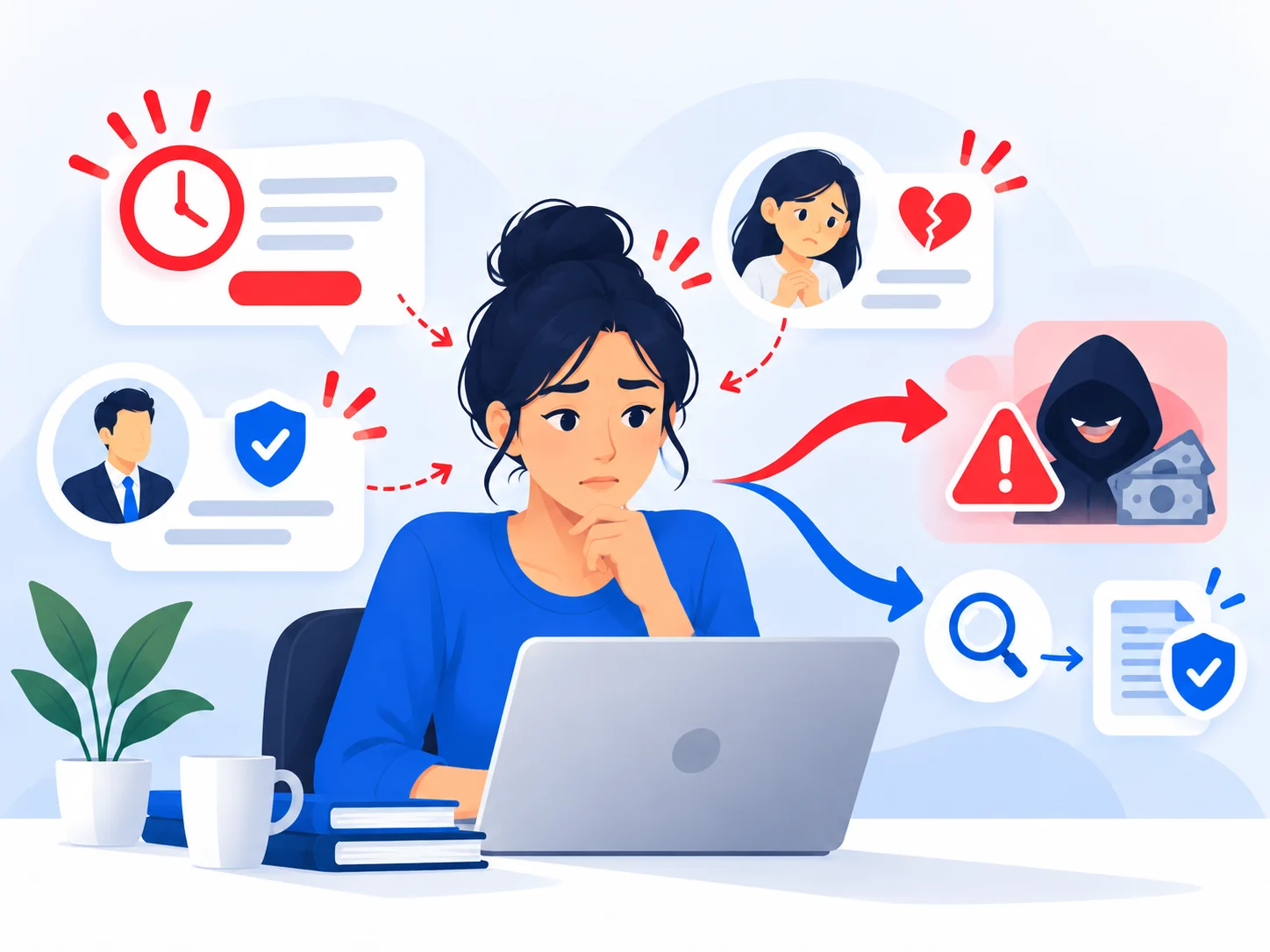
A scam changes the decision environment
The useful question is not “How could someone believe that?” It is what conditions made verification less likely at that moment?
A 2023 systematic review of online-fraud decision research found broad support for a pattern: faster, heuristic processing is associated with greater vulnerability, while more systematic processing can help people detect fraud. The review also cautioned that the underlying mechanisms are not fully settled and that many individual psychological factors do not produce simple, universal predictions.
That matters for prevention. A rule that creates time and distance can be more practical than trying to memorize every scam script.
Vulnerability is not the same as intelligence
Research on older adults has linked scam susceptibility with several factors, including cognition, literacy, psychological wellbeing, social support and financial fragility. These findings should not be stretched into a stereotype about age or intelligence.
One study of 639 community-dwelling older adults without dementia found higher scam susceptibility associated with older age and lower levels of cognitive function, psychological wellbeing, social support and literacy. Another study found an association between financial fragility and scam susceptibility even after accounting for cognition and financial literacy.
These are associations in specific study populations, not a diagnostic test for who will be scammed.
An experiment shows why awareness alone is not enough
A behavioral study exposed 644 older adults to a simulated government-impersonation scam using mail, email and a live phone agent. The researchers classified responses into three groups:
ScamMark visualization based on the study's published response categories and percentages. Source: JAMA Network Open / PubMed Central.
The practical lesson is not that a fixed percentage of people will fall for an impersonation scam. It is that convincing context can produce risky engagement even among people without diagnosed cognitive impairment.
Prevention should create friction before the irreversible step
Research does not give us a magic phrase that prevents every scam. It does support a useful design principle: make the safe behavior easier to perform before money, credentials or account control leave your hands.
Examples include:
- ending the call and finding the organization's number yourself;
- opening the official app rather than following a message link;
- having a family rule that large or unusual payments get a second check;
- delaying unfamiliar investment or payment decisions;
- using platform protections instead of moving a transaction off-platform;
- treating urgency as a reason to verify, not a reason to skip verification.
The strongest habit is independent verification
Scammers can imitate logos, websites, caller IDs, voices and social-media profiles. Verification is stronger when it uses a channel the suspicious contact did not control.
That is why ScamMark repeatedly recommends the same basic move: pause, leave the conversation, and verify independently.
Sources and references
These sources support the factual guidance and analysis on this page. For reporting, legal, financial or provider-specific procedures, follow the linked organization’s current instructions.
- Theoretical basis and occurrence of internet fraud victimisationFrontiers in Psychology (systematic review, 2023)
- Correlates of Susceptibility to Scams in Older Adults Without DementiaJournal of Elder Abuse & Neglect / PubMed Central
- Vulnerability of Older Adults to Government Impersonation ScamsJAMA Network Open / PubMed Central
- Financial fragility and scam susceptibility in community dwelling older adultsJournal of Applied Gerontology / PubMed Central