
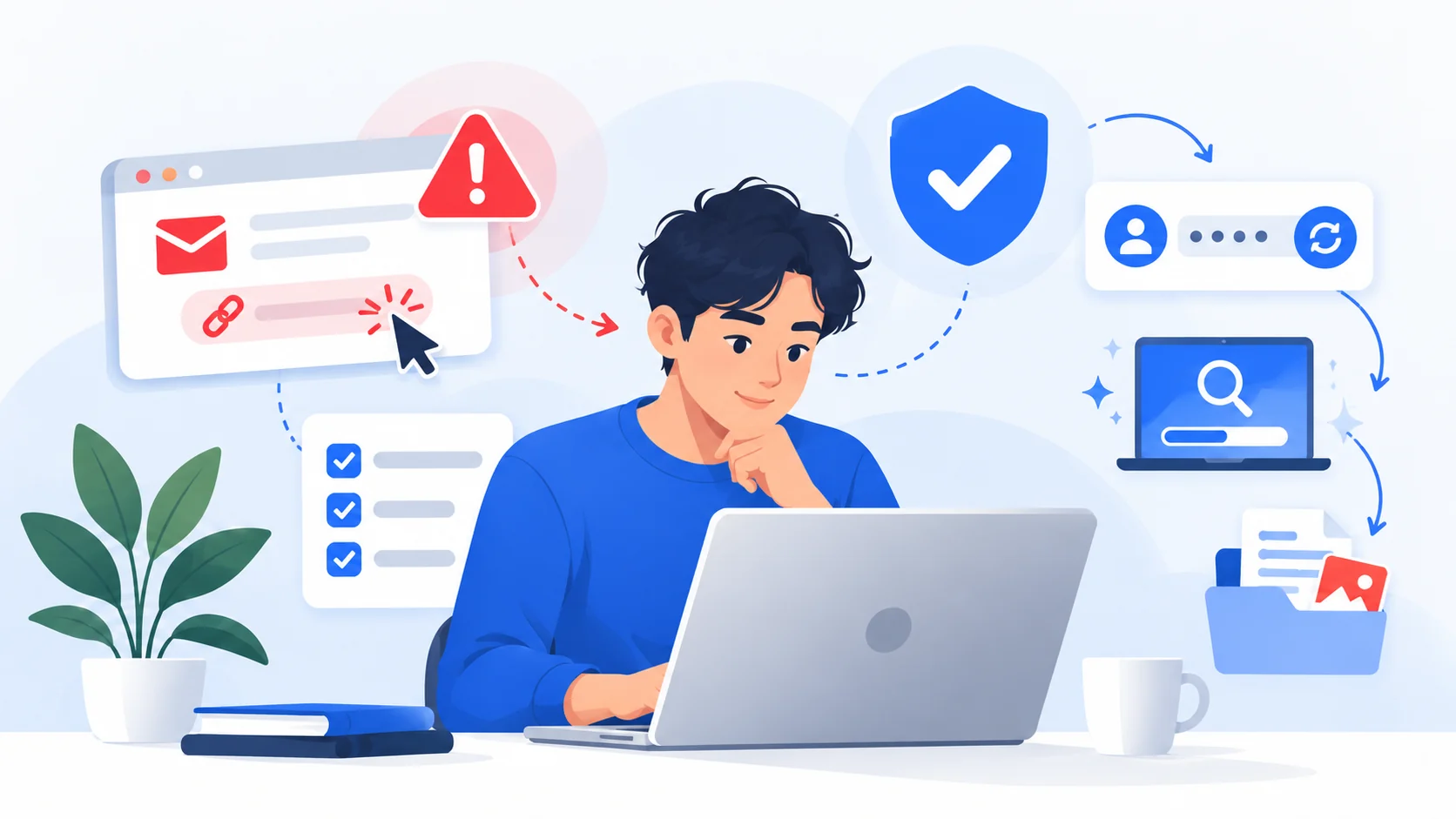
Before you send money or personal information
Do not decide based on the candidate's name, a familiar logo, the sender's phone number or a polished website. Each can appear in a misleading message. Instead, find out who controls this particular request and whether the payment or information request can be confirmed independently.
This is a scam-prevention guide, not a political endorsement, voting guide, campaign-finance legal opinion or official verification service. The U.S. examples below concern U.S. federal election fundraising; the same independent-verification habits can help readers dealing with political appeals in other countries, but local rules and registries differ.
A practical five-step verification sequence
- Stop using the request as your source of proof. Do not click its donation link, call its supplied number, scan its QR code or reply with personal details while you are uncertain.
- Identify the real requester. Record the exact organization name, the asserted affiliation, the website or account making the request and what it wants you to do. An organization's name alone does not identify the person behind a message.
- Check the organization independently. For a claimed U.S. federal political committee, search the Federal Election Commission's public committee records. Compare the committee name, identifier, committee type, treasurer and available filings. A close name match is a starting point, not proof the sender represents that committee.
- Check the claimed relationship and destination. Is it claiming to be a candidate's authorized campaign, an independent PAC, a merchant or a fundraiser? Verify that specific claim with the organization using a contact route you found independently. Confirm that the recipient and payment page belong to the intended organization before entering card details.
- Decide only after separating evidence from assumptions. If you cannot verify control of the request and where funds go, do not pay through it. You can support a cause through a different independently verified route if you choose.
A legitimate-looking link is not a guarantee: compromised websites, shared pages and redirected links can be abused. ScamMark's website and domain checker supplies limited technical signals, not an authenticity certificate for any campaign, committee, fundraiser or payment recipient. The suspicious-message guide explains the separate communication check.
Which election-related scams are documented?
The FBI's October 15, 2026 public warning, ahead of the November 3 U.S. midterm election, identifies these consumer-facing patterns. The warning describes risks and known scam methods; it is not a measurement of how common each pattern is in 2026.
| Pattern | What is suspicious | What to verify |
|---|---|---|
| Campaign “investment pool” | A supposed campaign contribution is presented as an investment that guarantees a payout after a candidate wins, sometimes with incentives to recruit others. | Do not treat a political donation as an investment. The FBI explicitly warns that campaign contributions do not generate investment returns. |
| Fake PAC or campaign solicitation | A person claims to collect money for a real committee or campaign but may divert the money. | Check the actual committee and independently establish that the particular solicitor and payment destination are connected to it. |
| Political merchandise non-delivery | An online seller takes payment for campaign-related goods but does not deliver. | Verify the merchant's identity, store terms, shipping claims, independent evidence and payment protections. |
| Registration-themed phishing | An unexpected message says urgent registration action is required and links to a convincing imitation page designed to collect private data. | Avoid the supplied link. Reach the relevant government authority through independently established official channels. Do not provide passwords or identifying data to the sender. |
| Synthetic-voice or image impersonation | Audio, images or messages imitate a political figure or trusted person to reinforce a demand for money or information. | Authenticate the requested action through a separate known channel. Artificial-looking or AI-generated media alone does not establish fraud. |
These patterns can overlap. For example, a misleading donation request can arrive through a phishing message and point to a legitimate service hosting attacker-controlled content.
What does the FEC actually tell you about a political fundraiser?
The FEC committee search includes registered federal political committees and related public filings. It helps establish what an entity reports to a regulator. It does not determine whether the person who emailed you actually represents that entity, whether a payment link is controlled by it, or whether a donation is advisable.
| Question | What the records can help establish | What remains unverified |
|---|---|---|
| Does a committee with this name exist? | Name, FEC ID, committee type and other public registration data | Whether the sender or website belongs to that committee |
| Is the committee candidate-authorized? | Committee designation and available FEC records for federal election activity | Whether an unrelated website or caller is genuinely acting for the authorized campaign |
| Is it an independent PAC or Super PAC? | Committee type and the fact that some committees operate independently | Independence is not itself fraud; whether any claimed endorsement or affiliation is truthful |
| Where does reported money go? | Filed receipts, spending categories and reports, subject to their coverage and processing delays | Whether one particular payment will reach the intended beneficiary, or whether suspicious spending proves criminal misconduct |
Important distinctions: The existence of a registered PAC is not a government seal of safety. An independent committee may legally support a candidate without being authorized by that candidate. An advertisement saying it is not authorized by a candidate can be consistent with legitimate independent spending. Check the FEC's disclaimer guidance rather than treating the wording itself as a scam signal.
Similarly, high fundraising, consulting or administrative expenses can justify closer scrutiny but do not independently prove fraud. A complaint or allegation is not a finding. A committee absent from a federal search may be outside that database's scope, or may require a different official lookup; absence alone is not a criminal determination.
Three questions to ask before donating
- Who receives the money? The named recipient in the payment flow should be identifiable and consistent with what was represented.
- What relationship was claimed? A campaign, a candidate-authorized committee and an independent political committee are not interchangeable.
- Can I confirm it without the solicitation? Use the official committee records, independently located organization details and established payment channels rather than the unsolicited message.
If you cannot resolve a material mismatch, do not use that payment link. ScamMark does not contact committees for you or certify one as legitimate.
What about political merchandise and unofficial sellers?
An unofficial political-shirt, sign or memorabilia seller is not automatically fraudulent. Nor does an official-looking advertisement demonstrate that a campaign endorsed it.
Treat it as an online purchase: identify the merchant, check an independently reachable business contact, read shipping and return policies, compare actual customer experiences when available, and prefer a payment method with applicable dispute protections. Verify any “official campaign store” claim with a separately located campaign source. A newly registered domain, HTTPS padlock, marketplace listing or recognizable logo is not a stand-alone verdict.
Use the existing online-store checks and marketplace-scam guide when your main concern is non-delivery or payment diversion.
What if the message mentions your registration or demands identity details?
The FBI describes fraudulent emails and texts that imitate a registration notice and lead to a counterfeit page. ScamMark does not give state-specific voting instructions. As a phishing response:
- Do not open the unsolicited link or provide identity documents, account credentials or codes to the sender.
- Contact the relevant government office using official contact information independently located—not the information in the message.
- If you already supplied a password or verification code, secure the affected accounts immediately and enable stronger authentication where available.
- If sensitive identifying information was exposed, review the FTC's identity-theft recovery resource and ScamMark's phishing recovery steps.
The FBI and CISA separately warned on October 16, 2026 about phishing and smishing affecting election and campaign officials. That institutional alert concerns a broader cyber-threat audience; it is not evidence that an individual message you received is malicious.
Can AI-generated campaign audio or video be trusted?
A realistic voice, photograph or video can be synthetic, edited, misattributed or genuine. None of those characteristics alone settles whether a financial request is authentic. Avoid making donations or disclosing information because a recording seems to come from a familiar person. Check the requester, exact demand and destination through an independent channel.
This is more robust than attempting to classify every image or voice as “real” or “fake.” ScamMark does not perform forensic audio or image authentication.
If you already sent money or disclosed information
Act on the controllable risk first, then report:
- Stop contact and payments. Do not send a second amount to unlock a refund, donation receipt or “verification.”
- Contact the payment provider immediately. Ask the card issuer, bank, payment app or transfer service what dispute, cancellation or recall options exist; timing and eligibility vary. Start with ScamMark's payment-recovery guide.
- Secure exposed accounts. Change compromised passwords via the real service, review sessions and enable multifactor authentication. For identity exposure, use FTC IdentityTheft.gov.
- Preserve evidence privately. Save dates, transaction references, sender identities, exact URLs, emails, receipts and screenshots. Do not publish identifying information online or upload it to an unknown “investigator.”
- Report to the appropriate authority. For a suspected U.S. consumer scam use FTC ReportFraud; for eligible internet-enabled crime use FBI IC3. Questions about federal political-committee disclosures are different from a consumer fraud complaint; consult the FEC for its regulatory scope. Outside the United States, use the relevant local agencies via ScamMark's global reporting guide.
Reporting does not guarantee investigation, reimbursement or criminal prosecution. FTC's recovery advice explains why early payment-provider contact matters.
A short verification checklist to save or print
Before acting on an unsolicited election-themed appeal, confirm each statement independently:
- [ ] I identified the actual recipient and what is being requested.
- [ ] I did not use the sender's links or telephone number as verification.
- [ ] I checked the correct official registry where one applies, without treating registration as endorsement.
- [ ] I distinguished a candidate-authorized committee from an independent group.
- [ ] I verified any claimed affiliation using independently sourced details.
- [ ] I checked the specific payment destination and whether applicable protections exist.
- [ ] I rejected any promise that a campaign donation is a guaranteed investment.
- [ ] If I could not verify a key claim, I stopped instead of guessing.
You can print this page or share its permanent URL. ScamMark does not ask for, collect or retain answers to this checklist.
Sources, scope and review
Primary warning: FBI IC3, published October 15, 2026. Additional cyber-alert: FBI/CISA, published October 16, 2026. Verification: FEC committee records and disclaimer guidance; FTC fraud and recovery guidance. All linked official resources in the source list were reviewed October 19, 2026.
This guide is nonpartisan and focused on scam prevention, not election outcomes or political persuasion. It does not name any particular committee, candidate or seller as fraudulent. It describes the U.S. federal framework only where specified; international readers should use their own jurisdiction's authorities and disclosure rules. Registry results, filings and reporting procedures can change. Recheck official sources before relying on current status, and refresh this guide after the November 2026 election if relevant guidance changes.
Sources and references
These sources support the factual guidance and analysis on this page. For reporting, legal, financial or provider-specific procedures, follow the linked organization’s current instructions.
- Scammers Exploit 2026 U.S. Midterm Election to Perpetrate Multiple Fraud Schemes (October 15, 2026)FBI Internet Crime Complaint Center
- Cyber Threat Actors Use a Variety of Techniques to Target Election and Campaign Officials (October 16, 2026)FBI and CISA
- Browse committees and their public filingsU.S. Federal Election Commission
- Advertising and disclaimersU.S. Federal Election Commission
- Guides to candidates, political committees and PACsU.S. Federal Election Commission
- What To Do if You Were ScammedU.S. Federal Trade Commission
- How To Recognize and Avoid Phishing ScamsU.S. Federal Trade Commission